Author: FENG Jiahao |
Researchers from the Changchun Institute of Optics, Fine Mechanics and Physics, Chinese Academy of Sciences, together with collaborators at Changchun University of Science and Technology, reported a hardware-based optimization strategy for intersatellite laser links in Optics Communications. The paper introduced a signal processing architecture combining complex rotation algorithms with error correction coding, effectively solving the interference problem between data transmission and precision ranging in space gravitational wave detection.
Future space missions, such as Taiji and LISA, rely on laser interferometry between satellites separated by millions of kilometers to listen to the universe. These laser links serve a critical dual purpose: measuring minute distance changes to detect gravitational waves and transmitting scientific data between spacecraft.
However, integrating these functions creates a fundamental technical conflict. The modulation required to encode communication data inevitably disturbs the laser's phase, introducing noise that can obscure the picometer-level displacements caused by gravitational waves. Classical methods often struggle to filter out this "communication jitter" without compromising data reliability.
To address this challenge, the team designed a robust processing system implemented on a Field Programmable Gate Array (FPGA).
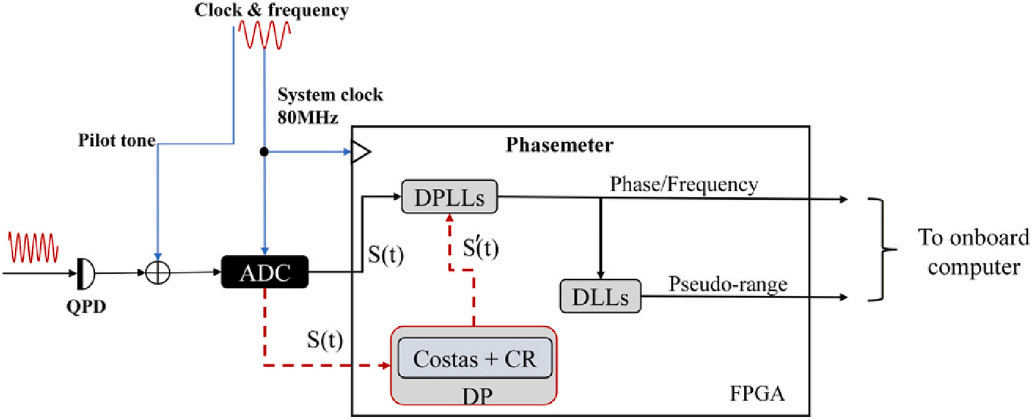
Fig. 1.Phasemeter architecture coupled with a demodulated phase module.
The proposed architecture introduces a dedicated parallel processing path (red dashed line) alongside the conventional loop. By routing the signal through a specialized Demodulated Phase (DP) module, the system actively identifies and removes modulation interference before the signal reaches the sensitive phase measurement core.
The core innovation lies in this "complex rotation" demodulation technique. Unlike traditional designs that passively filter signals, this approach actively reconstructs the noise profile created by the data modulation and mathematically subtracts it from the carrier wave. This process effectively "cleans" the signal before it enters the sensitive phase measurement loop, isolating the gravitational wave detection channel from the communication stream.
A major hurdle in this approach is the reliance on data accuracy. If the system misreads the communication bits due to signal fading, the subtraction process fails and reintroduces noise. To prevent this, the researchers incorporated Reed-Solomon (RS) error correction coding. This industry-standard coding scheme allows the system to repair corrupted data sequences instantly. By ensuring that the data used for the "cleaning" process is error-free, the system maintains high-precision performance even when the received signal strength fluctuates, creating a stable environment for measurement.
The research process moved from theoretical modeling to rigorous hardware verification. The team constructed a unified electronic platform to simulate the harsh conditions of intersatellite links. Experiments showed that the proposed method significantly suppressed the noise floor compared to conventional uncompensated systems. The architecture successfully delivered a pure carrier wave for ranging while maintaining a reliable data link, proving that communication and high-precision measurement need not be mutually exclusive.
Taken together, the study demonstrates that carefully integrating advanced error correction with hardware-accelerated signal processing can unlock the extreme sensitivity required for gravitational wave astronomy. By neutralizing modulation noise at the source, this technology clears the way for future observatories to detect the faintest vibrations of spacetime with unprecedented clarity and reliability.

 中文
中文